Harris' Restaurant menu, graded
Show the proof. The dry-aging room does the selling.
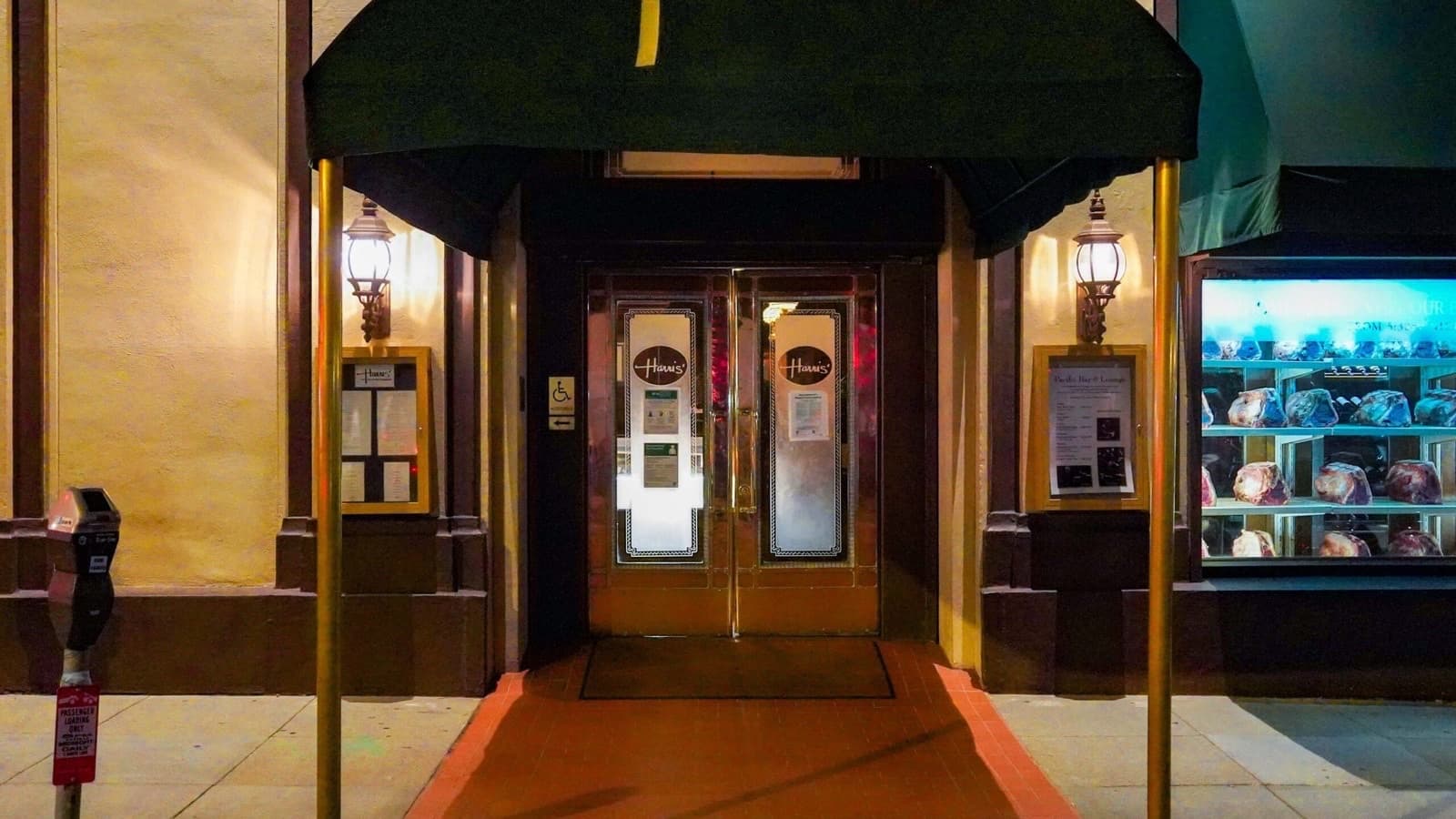
Sutherland's rule for trust: don't claim quality, demonstrate it at visible cost. Harris' built a window onto its aging room and lets the beef make the case.
Menu-craft grade
The dry-aging window is an unusually strong costly signal, paired with round prestige pricing and bundled sides. The window's proof never reaches the page, where the menu could be doing more of the selling.
Graded on how well the menu uses behavioral economics, not the food.
Menu and prices verified September 2026
A 3-minute audio read of the analysis
- Type
- Independent
- Where
- San Francisco, Polk Gulch
- Cuisine
- Classic steakhouse
- Footprint
- 1 location
- Since
- 1984
- Ownership
- Independent, chef-owned (Michael Buhagiar, family-run)
The mechanics, drawn
The same menu, mapped onto an axis, so the behavioral move is something you can see, not just read.
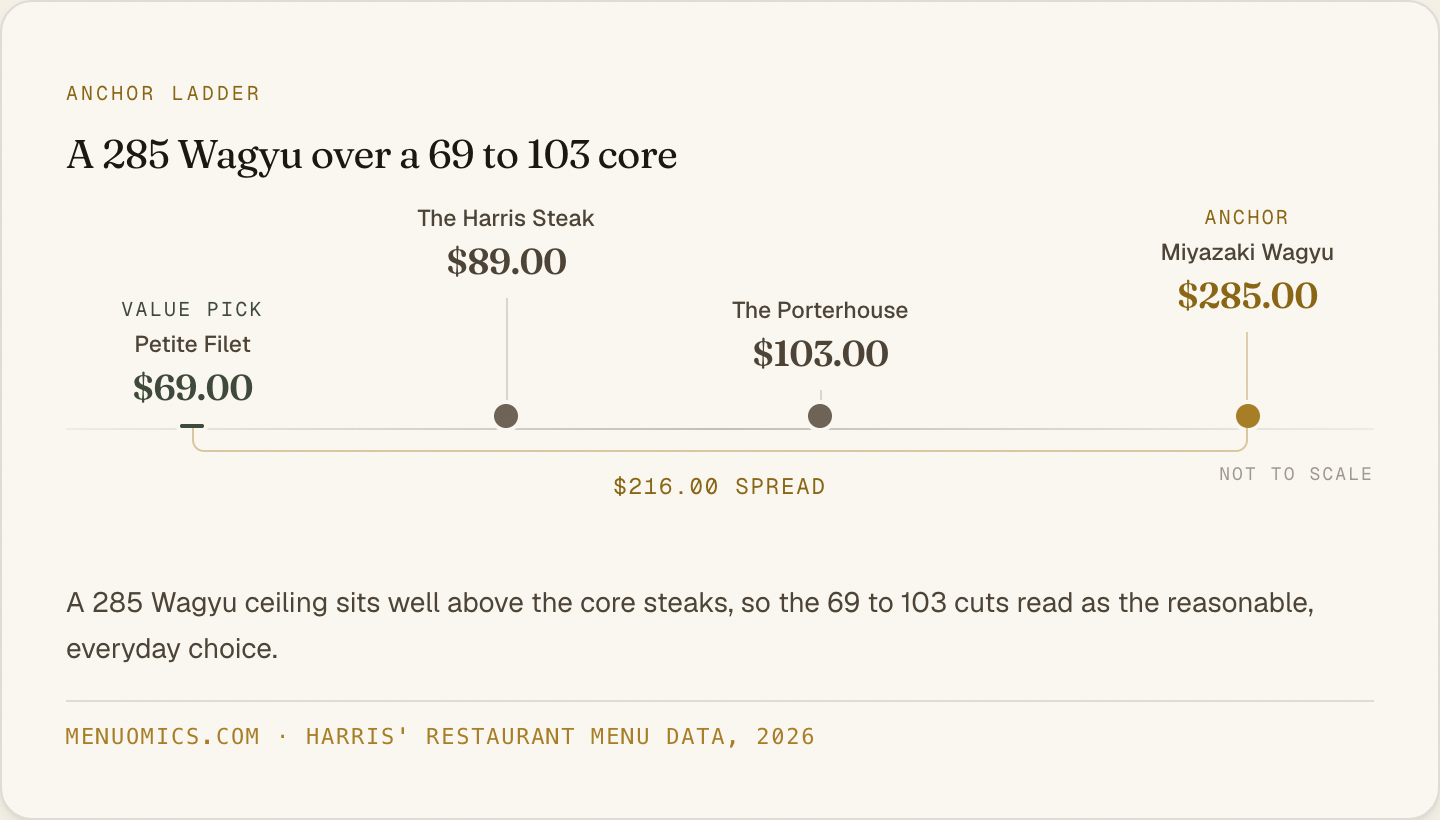
A 285 Wagyu over a 69 to 103 core
A 285 Wagyu ceiling sits well above the core steaks, so the 69 to 103 cuts read as the reasonable, everyday choice.
Download this chart (PNG) · free to reuse with credit, see reuse terms.
The setup
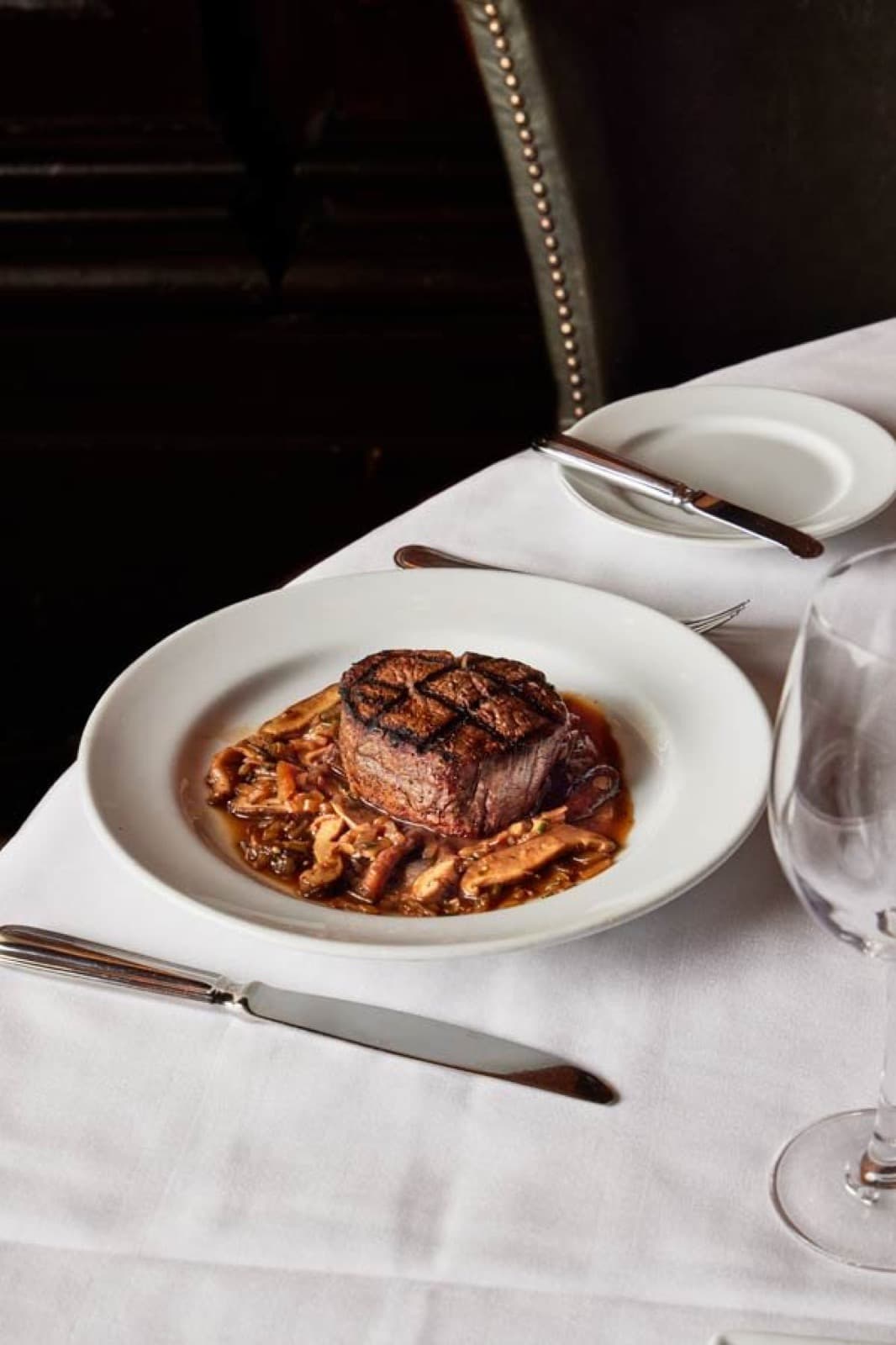
Harris' has aged prime beef hanging behind glass you can see from Van Ness Avenue. Before a single word of menu copy, the proof is on display: rows of porterhouses butchered in house. Prices are round and large, "$103," "$89," no cents, no charm endings.
Everything visible here is a deliberate signal of quality and seriousness, which is exactly how Sutherland says trust is really built: through costly, hard-to-fake demonstration, not adjectives.
What they get right
The behavioral economics already at work.
The dry-aging window is a costly signal
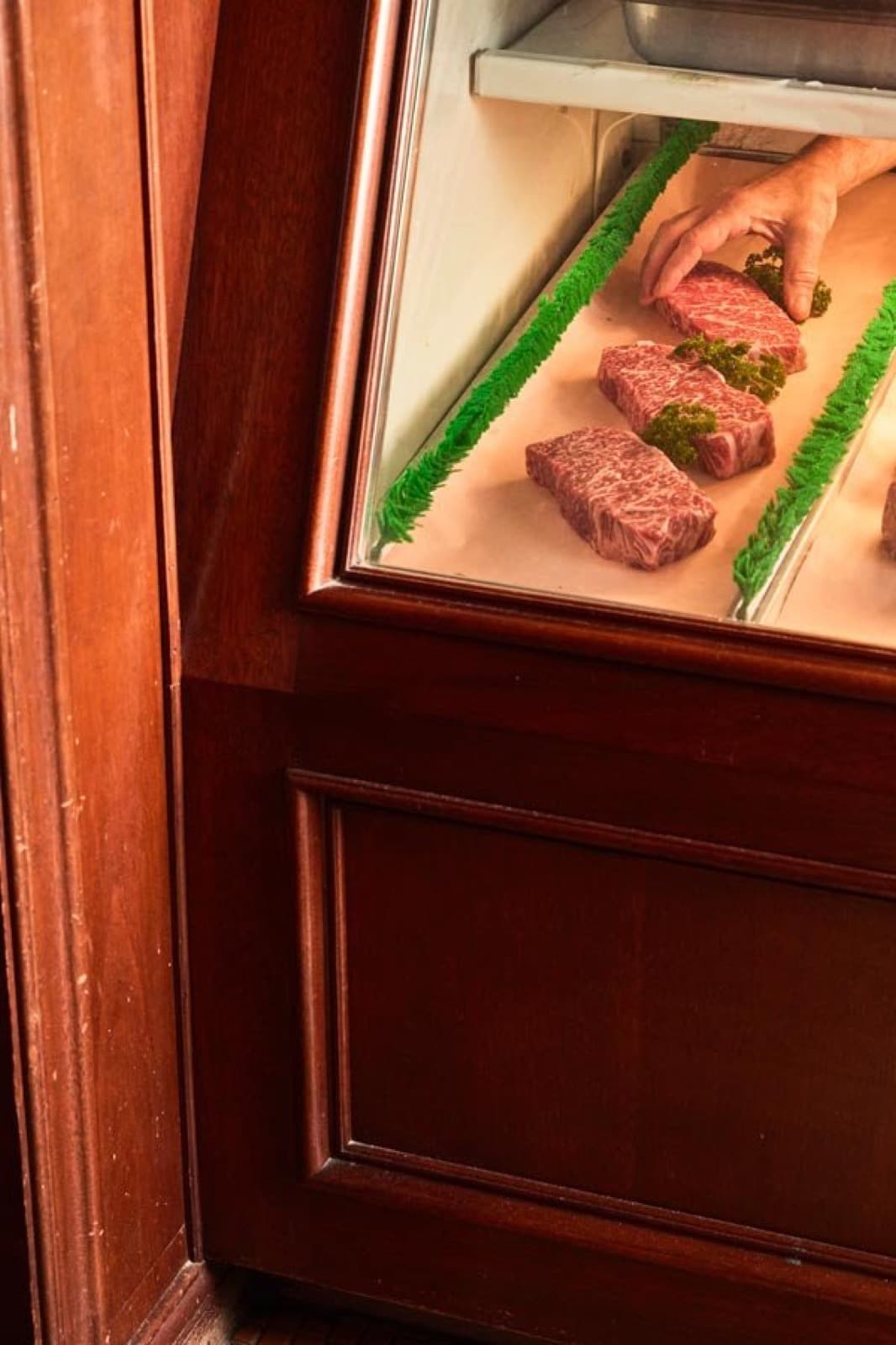
A glass-walled aging room is expensive, hard to fake, and impossible to argue with. It does what no menu adjective can: it proves the quality before you order and removes the uncertainty that makes people hesitate at a three-figure steak.
Rory Sutherland on costly signalling and reducing uncertainty
Round prices, no cents
"$103," not "$102.95." Charm endings would cheapen a 40-year-old steakhouse. Round whole numbers read as confidence and quality, exactly right for the room.
Schindler & Naipaul on round-vs-charm pricing
The $285 Wagyu is an anchor
A 13oz A5 Miyazaki Wagyu Ribeye at $285 sits well above the core list and quietly reframes the $69 to $103 steaks as the sensible choice. The most expensive item rarely needs to sell; it needs to make the cuts below it look reasonable.
a high anchor pulls choice toward the upper-middle, Kahneman & Tversky; Simonson & Tversky
Sides are bundled, not a la carte
Each steak includes sauteed seasonal vegetables and a choice of potato. One price for the plate hurts less than itemizing every side, and removes the nickel-and-dimed feeling rival steakhouses get criticized for.
Thaler, mental accounting
What we’d test
The rewrite, with the expected lift and the honest caveat.
Put the window in the menu
The aging room is the restaurant's strongest sales argument, and most diners only glimpse it on the way in. A line on the menu ("aged 21 days, in the room you passed") turns visible proof into a reason to trade up to the dry-aged cuts.
Expect More orders of the higher-margin aged steaks
Caveat A menu-copy change: one confident line, the steakhouse voice is understatement.
Lead with the cut just below the anchors
Order the beef list so the cut Harris' most wants to sell sits just under the Wagyu and Porterhouse, in the reasonable middle, rather than buried at the bottom.
Expect Mix shift toward the target cut
Caveat A menu-ordering change: keep the Wagyu and Porterhouse visible, they do the anchoring work.
Give the aged cuts a "Dry-Aged" section header
Group the qualifying cuts under a dedicated "Dry-Aged" header that states the aging duration (for example, "Dry-Aged 21 Days") right beside them. The header carries the window's proof into the menu's structure and labels exactly which steaks earn it.
Expect Clearer trade-up path to the aged steaks
Caveat A menu-sectioning change: state only the aging window the kitchen actually runs.
What diners actually say
Synthesized from public reviews, the reality check that grounds every recommendation.
They praise
- The dry-aged steaks
- Classic, attentive old-school service
- Old-world room and martinis
- Generous, included sides
They criticize
- Service can slip on off-nights
- Expensive, "coasting on the name" to some
- Old-school can read as dated
The verdict
Harris' has a rare and persuasive sales tool and it is made of glass: a dry-aging room you see before you sit. Add round confident prices, a $285 Wagyu anchor above a $69 to $103 core, and bundled sides, and the menu barely has to argue. The opportunity is to bring the window's proof onto the page: name the aging duration, group the aged cuts under their own header, and lead with the middle.
Common questions
- How much is a steak at Harris' Restaurant in San Francisco?
- The signature 24oz dry-aged Porterhouse is $103, the bone-in Harris Steak is $89, and the Petite Filet Mignon starts at $69, each including sauteed vegetables and a potato. Prices are round whole dollars with no cents, because charm endings would cheapen a 40-year-old steakhouse and round numbers read as confidence.
- Why is there a glass window of aging beef at Harris'?
- Harris' dry-ages its prime beef behind a streetside glass window you can see from Van Ness Avenue, before any menu copy. A glass-walled aging room is expensive and hard to fake, so it proves the quality and removes the uncertainty that makes people hesitate at a three-figure steak.
- What is the most expensive item at Harris'?
- The 13oz A5 Miyazaki Wagyu Ribeye is $285, well above the $69 to $103 core steaks. The most expensive item rarely needs to sell, it just makes the cuts below it look reasonable, which is exactly the anchoring job it does here.
- Are sides included at Harris' Restaurant?
- Yes, every steak includes sauteed seasonal vegetables and a choice of potato at one price, so the $89 Harris Steak is not a la carte. One bundled price hurts less than itemizing each side and removes the nickel-and-dimed feeling rival steakhouses get criticized for.
More breakdowns
 Restaurant Gary DankoA
Tiered courses, round whole-dollar prices, a caviar anchor, build-your-own freedom and a tableside cheese cart. Danko is already doing what we'd recommend.
Read the Restaurant Gary Danko breakdown → Saint Frank CoffeeB+
An SF specialty roaster that prices a latte at a fine-coffee premium and justifies it with a story: named farms, tasting notes, and a 'relationship coffee' ethos that turns a cup into a cause.
Read the Saint Frank Coffee breakdown → Yank SingA-
A 1958 dim sum institution where you pick from a rolling cart by sight, plate by plate, and the bill quietly adds up.
Read the Yank Sing breakdown →A Michelin-starred Fillmore room where small plates roam by on dim-sum carts at $3 to $14 each, so you say yes one plate at a time and the check climbs on its own.
Read the State Bird Provisions breakdown → Zuni CafeA-
A 75.00 chicken that takes about 75 minutes, and the menu says so. A practical warning that also happens to reduce uncertainty, printed in the margin.
Read the Zuni Cafe breakdown → Pearl 6101B+
A neighborhood Outer Richmond Cal-Mediterranean restaurant from the Pizzetta 211 team, whose menu prints prices as bare round numbers with no dollar signs and no cents.
Read the Pearl 6101 breakdown →Your menu next
Get this for your own menu, free.
Send your menu and we’ll send back the same breakdown, what you get right, what we’d test, and why.
Routier
An elegant, romantic neighborhood bistro in Lower Pacific Heights serving modern French cooking with a Californian accent, from chef JP Carmona and the B Patisserie team.
Read it →