Taco Bell menu, graded
Value as the headline, scarcity as the engine: anchor everything to a sub-$3 menu, name the bundle after its price, then run a constant limited-time calendar so there is always a reason to come back
Most fast-food menus chase the average check up. Taco Bell anchors the whole board to a sub-$3 value menu, bundles the deal into a round $5, $7 or $9 box, and runs a constant drumbeat of limited-time drops so there is always a reason to return.
Menu-craft grade
An exceptionally complete value-and-scarcity playbook: a sub-$3 Luxe Value Menu anchors the whole board as cheap, the $5/$7/$9 Luxe Cravings Boxes name the bundle after its price and stack a good-better-best ladder, a constant limited-time calendar (Nacho Fries, the Mexican Pizza revival, nostalgia drops) manufactures FOMO and return visits, and a free app loyalty program pulls ordering into first-party data. Held back from an A by the value backlash: prices have risen at more than double inflation, and the 'Luxe' rebrand that cut old favorites read to fans as a hike in disguise.
Graded on how well the menu uses behavioral economics, not the food.
Menu and prices verified September 2026
A 4-minute audio read of the analysis
- Type
- Chain
- Where
- Irvine, CA
- Cuisine
- Mexican-inspired fast food
- Footprint
- ~8,200 US locations; ~9,000 worldwide
- Since
- 1962 (Downey, CA)
- Ownership
- NYSE: YUM (Yum! Brands)
The mechanics, drawn
The same menu, mapped onto an axis, so the behavioral move is something you can see, not just read.
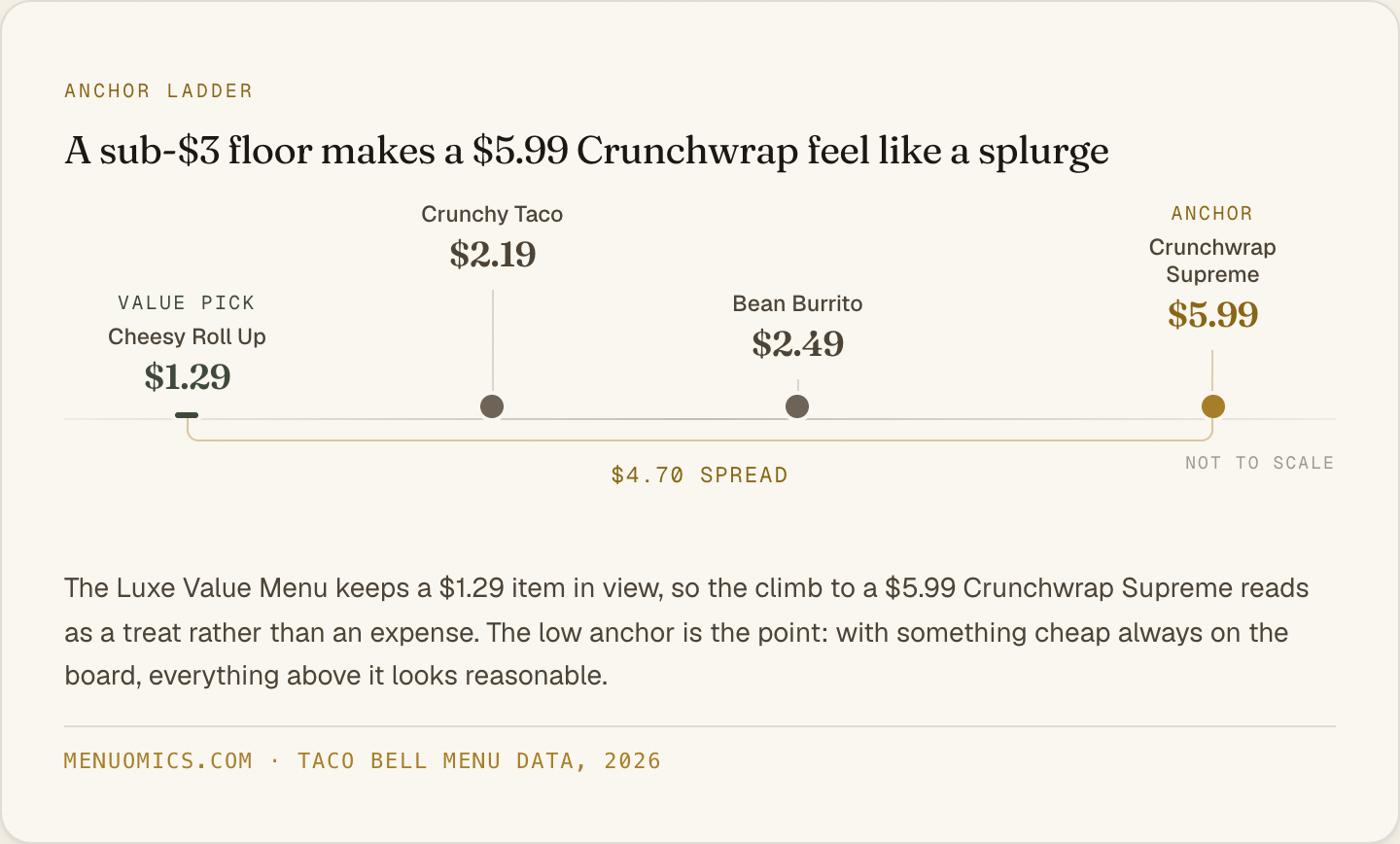
A sub-$3 floor makes a $5.99 Crunchwrap feel like a splurge
The Luxe Value Menu keeps a $1.29 item in view, so the climb to a $5.99 Crunchwrap Supreme reads as a treat rather than an expense. The low anchor is the point: with something cheap always on the board, everything above it looks reasonable.
Download this chart (PNG) · free to reuse with credit, see reuse terms.
The full ticket
What it actually rings up to.
The headline price is only the start. The real number is the journey from a base order to the check at the register, one easy yes at a time.
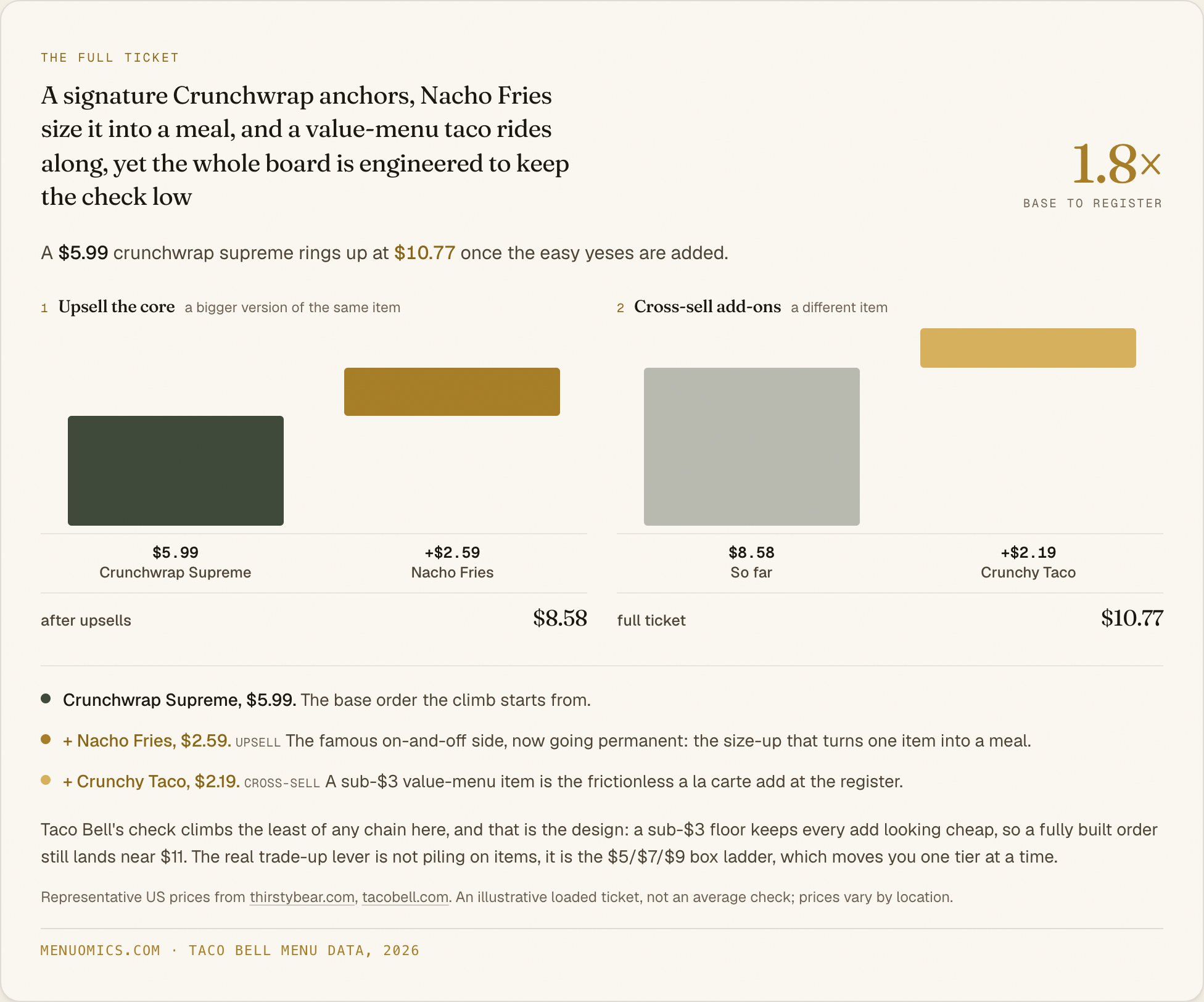
A signature Crunchwrap anchors, Nacho Fries size it into a meal, and a value-menu taco rides along, yet the whole board is engineered to keep the check low
A $5.99 crunchwrap supreme rings up at $10.77 once the easy yeses are added.
- Crunchwrap Supreme, $5.99. The base order the climb starts from.
- + Nacho Fries, $2.59. upsell The famous on-and-off side, now going permanent: the size-up that turns one item into a meal.
- + Crunchy Taco, $2.19. cross-sell A sub-$3 value-menu item is the frictionless a la carte add at the register.
Taco Bell's check climbs the least of any chain here, and that is the design: a sub-$3 floor keeps every add looking cheap, so a fully built order still lands near $11. The real trade-up lever is not piling on items, it is the $5/$7/$9 box ladder, which moves you one tier at a time.
Representative US prices from thirstybear.com, tacobell.com. An illustrative loaded ticket, not an average check; prices vary by location.
Download this chart (PNG) · free to reuse with credit, see reuse terms.
The setup
Taco Bell opened in 1962 in Downey, California, built by Glen Bell, and grew under Yum! Brands (NYSE: YUM) to roughly 8,200 US locations and 9,000 worldwide. Its menu is Mexican-inspired American fast food, tacos, burritos, quesadillas and nachos, and it is the rare chain that gained traffic during the 2024 to 2025 consumer pullback, posting roughly 8 to 9% same-store growth while rivals' foot traffic fell. It is, by most measures, the QSR value leader.
What makes the board interesting is how deliberately it is engineered around value and scarcity. A sub-$3 Luxe Value Menu anchors everything, the $5/$7/$9 Luxe Cravings Boxes collapse the deal into the price itself, and a near-constant limited-time calendar, a new platform roughly every four to five weeks, keeps the menu feeling fresh. (Taco Bell does not frame these as behavioral tactics; this is our reading of the observed design.)
What they get right
The behavioral economics already at work.
The sub-$3 value menu is the low anchor for everything
The Luxe Value Menu puts ten items at $3 or less, with a Cheesy Roll Up near $1.29, in permanent view. That low reference price makes the $5.99 Crunchwrap and even the $9 box read as reasonable rather than expensive. The cheap item rarely needs to sell; it just needs to set the number everything else is judged against.
anchoring (Tversky & Kahneman 1974); Taco Bell's Luxe Value Menu (ten items, $3 or less)
The box is named after its price, which kills friction
The $5, $7 and $9 Luxe Cravings Boxes collapse the entire pricing decision into the product name, so there is nothing to add up and the choice becomes which tier, not whether to buy. Taco Bell markets the boxes near 55% off the a la carte sum, the classic move of hiding the weakest item's price inside one attractive number, and the three tiers form a textbook good-better-best ladder that nudges you up one step at a time.
Taco Bell's $5/$7/$9 Luxe Cravings Boxes, marketed near 55% off a la carte; bundling and the compromise effect
The limited-time calendar manufactures scarcity and return visits
Taco Bell launches a new platform roughly every four to five weeks and treats fan-favorites as scarce events. Nacho Fries debuted to about 53 million orders in five weeks and were then run on and off for years; the Mexican Pizza was discontinued, revived by a 171,000-signature petition, and sold a six-month supply in two weeks. Scarcity reliably raises perceived value, and the rotating calendar gives regulars a reason to keep checking back.
Worchel, Lee & Adewole 1975 (scarcity and perceived value); Nacho Fries and the Mexican Pizza revival
Every core item has a 'make it Supreme' upgrade path
Nearly every item climbs: a Crunchy Taco becomes a Doritos Locos Taco becomes a Supreme, a quesadilla adds steak or chicken, fries size up. Taco Bell markets roughly a million customizable combinations and an in-app 'Make it Fresco' toggle, so the upsell feels like the customer's own choice rather than a push. Customization raises both perceived ownership and the average check.
the 'make it Supreme' upgrade path and Taco Bell's ~1 million customizable combinations
The app pulls ordering into first-party data
Taco Bell Rewards is free and digital-only: ten points per dollar, a 'Hot' to 'Fire' tier ladder, and redemptions that exist only in the app, where the parent has publicly targeted moving toward 100% digital transactions. Because points are earned and spent only on first-party channels, the program pulls volume into the app, where price is less salient at the moment of choice and offers can be personalized. (The Taco Lover's Pass daily-taco subscription works the same way when it returns, as a prepaid commitment.)
Taco Bell Rewards (10 points per dollar; Yum's stated 100% digital goal); the intermittent Taco Lover's Pass subscription
What we’d test
The rewrite, with the expected lift and the honest caveat.
Show the box's a la carte savings on the box itself
The boxes are marketed near 55% off, but the saving is not stated at the point of choice, where it would do the most work. Printing 'about $11 of food for $7' on the box makes the discount concrete and anchors the deal as a win, which is exactly when a stated saving raises perceived value most. The math already favors the box; the board just has to show it.
Expect A higher box attach rate as the saving reads on the page, lifting the average check
Caveat Menu-copy only: it states the existing bundle saving, it does not change pricing, portions, or the food.
Put a visible 'limited time' window on the LTO items
Items like the flavored Nacho Fries spin-offs are already scarce, but the board does not state how scarce. Labeling them explicitly as available for a short window makes the scarcity legible at the point of choice, which is when it raises perceived value and urgency most. The limited run already exists; the wording carries the FOMO.
Expect A lift in trial of the limited items as the scarcity reads on the board
Caveat Menu-copy only: it names an existing limited item, it does not change pricing, portions, or availability.
Surface the make-it-Supreme upgrade inline on each core item
The Supreme upgrade exists on most items, but the board rarely states the relationship next to the base item. Placing the base and the Supreme adjacent, with the small upcharge shown, makes the good/better step legible at the moment of decision, the way a visible trade-up nudges the mix upward without an aggressive push. The upgrade already exists; the layout carries it.
Expect A higher Supreme attach rate as the upgrade reads as the easy next step
Caveat Menu-layout only: it surfaces an existing upgrade, it does not change pricing, portions, or what is served.
What diners actually say
Synthesized from public reviews, the reality check that grounds every recommendation.
They praise
- The QSR value leader: it gained traffic while rivals shrank during the 2024 to 2025 pullback
- Iconic, craveable items: Baja Blast and the Crunchwrap are genuine signatures
- Easy customization and vegetarian-friendly: a certified veg menu and an in-app 'Make it Fresco' toggle
- A steady drumbeat of buzzy limited-time and nostalgia drops keeps the brand culturally relevant
- The $5/$7/$9 boxes are real value, usually cheaper than ordering the same items a la carte
They criticize
- Value is not as cheap as it was: prices rose at more than double the inflation rate over the past decade
- Widespread shrinkflation complaints, smaller portions and cups, are a recurring social gripe
- The January 2026 'Luxe' rebrand cut old value favorites, which fans read as a hike in disguise
- Discontinuation-and-return churn: favorites vanish, then come back at higher prices
- Some new 'value' items are reviewed as small or skimpy for the price
The verdict
Read as menu design, Taco Bell is the value-war master: a sub-$3 menu anchors the whole board as cheap, the $5/$7/$9 boxes collapse the deal into a single memorable number that trades you up a tier at a time, a near-constant limited-time calendar manufactures scarcity and return visits, and a digital-only loyalty program quietly pulls the whole thing into first-party data. It is sophisticated enough that Taco Bell gained traffic while rivals lost it. The catch is the one the value leader can least afford: prices have outrun inflation and the 'Luxe' rebrand cut favorites, so the loudest complaint is that the value is not as cheap as the brand built its name on. The upside left on the table is honest and small: show the box saving on the box, put a visible window on the limited items, and surface the Supreme upgrade inline, so the value and the scarcity the menu already runs are legible at the moment of choice.
Common questions
- Why is Taco Bell more expensive now?
- Taco Bell earns an A- for menu craft, but the value reputation is straining: an analysis found it raised prices at more than double the inflation rate over the past decade. The board still leads with a sub-$3 Luxe Value Menu that anchors everything as cheap, yet the items above it have crept up and a January 2026 rebrand to 'Luxe' removed some old value favorites, which fans read as cover for a price hike.
- Is the Taco Bell Cravings Box worth it?
- The $5, $7 and $9 Luxe Cravings Boxes are Taco Bell's strongest value play: the box is marketed near 55% off the same items ordered separately, so it is usually cheaper than building the order a la carte. The trick is the name, the price IS the product name, which removes the friction of pricing each item and quietly trades you up one tier at a time.
- What is the Luxe Value Menu at Taco Bell?
- As of January 2026 the value menu was rebranded the 'Luxe Value Menu,' ten items each $3 or less, from a ~$1.29 Cheesy Roll Up to a Spicy Potato Soft Taco. It is the low anchor of the whole board: with a sub-$3 floor in view, the $5.99 Crunchwrap and the boxes read as reasonable rather than expensive.
- Are Taco Bell Nacho Fries permanent now?
- Yes, mostly. Nacho Fries debuted in 2018 as a limited-time item (about 53 million orders in the first five weeks) and were run on and off for years to manufacture FOMO. In 2026 Taco Bell announced they are becoming a permanent menu item for the first time, rolling out over the year, though flavored spin-offs stay limited-time.
- Is the Taco Lover's Pass still available?
- Not right now. The Taco Lover's Pass, an app subscription of about $10 for one taco a day for 30 days, launched in 2022 and has since reverted to an on-and-off offer. As of mid-2026 it is not available, but it periodically returns, often around National Taco Day in early October, so the app is the only way to confirm a date.
- What is the most expensive item at Taco Bell?
- On the standard menu, the priciest single item is the Crunchwrap Supreme, about $5.99 in representative 2026 US pricing (it varies by location; group packs and combo deals can cost more). That top price also does quiet work as the menu's anchor: it is the number that makes everything below it read as reasonable.
- How much is a meal at Taco Bell?
- A meal at Taco Bell starts around $5.99 for the base order and lands near $10.77 once the usual add-ons go on, roughly 1.8x the headline price (representative 2026 US figures; they vary by location). That gap between the price that gets you in and the total you pay is the multiplier this page grades.
Sources (6)
- Wikipedia, Taco Bell (founding, ownership, cuisine, history)
- Taco Bell Newsroom, the new Luxe Value Menu (January 2026)
- Taco Bell Newsroom, the $5/$7/$9 Luxe Cravings Boxes
- Taco Bell, Rewards and the Taco Lover's Pass (loyalty, subscription status)
- TheStreet, Taco Bell makes Nacho Fries permanent (2026)
- thirstybear, Taco Bell menu with prices (2026, representative)
Head to head
More breakdowns
 The Cheesecake FactoryB+
A 21-page, 250-item menu should be a behavioral disaster. It's a roughly $4-billion chain. Here's what all that abundance is quietly doing.
Read the The Cheesecake Factory breakdown → McDonald'sA-
The Extra Value Meal is one of the most-copied ideas in food: fold the whole order into a single number that hurts less than three. Then McValue and the app pile value on top, and the McRib drops in as an event.
Read the McDonald's breakdown → Dunkin'A-
A premium latte anchors the cheap iced coffee as the obvious default, the $6 Meal Deal bundles the breakfast, and Dunkin' Rewards turns the morning run into a streak. The menu craft is textbook; the strain is price creep and an app that increasingly decides the real price.
Read the Dunkin' breakdown → Panda ExpressB+
The whole order comes down to one question, how many entrees. A Bowl is one, a Plate is two, a Bigger Plate is three, and the menu is built so the middle Plate wins. Orange Chicken is the anchor everyone orders, and a quiet $1.50 premium upcharge lifts the check while the headline price stays put.
Read the Panda Express breakdown → Raising Cane'sA-
The chicken-finger chain that built a billion-dollar machine by refusing to sell almost anything else.
Read the Raising Cane's breakdown → PopeyesB-
The chain that proved a sold-out sign sells harder than any coupon. We grade the menu craft behind the chicken-sandwich phenomenon, not the hype.
Read the Popeyes breakdown →Your menu next
Get this for your own menu, free.
Send your menu and we’ll send back the same breakdown, what you get right, what we’d test, and why.
Panera Bread
A flat $14.99 a month makes the coffee feel free and the visits automatic; once you are inside, a $13 You Pick Two and a $9.79 bread bowl do the rest. Panera does not just sell lunch, it sells a subscription to the habit of buying lunch.
Read it →